

Winning the Data Battle Governance as the Key to Trust and Transformation
In this modern world Data Governance is the mighty sword to win the battle to gain the stakeholders satisfaction. Master Data Experts are struggling to win the battle that ensures it is accurate, secure, and available properly used through their soldiers no other than resources in lifecycle.
It involves establishing policies, standards, roles, and responsibilities to maintain data quality, integrity, privacy, and compliance with regulations. Effective data governance enables trustworthy data for informed decision-making, operational efficiency, regulatory compliance, and strategic business initiatives.
The Battlefront of Data Governance
Defining Clear Roles and Responsibilities:
Assigning well-defined roles such as data owners and stewards is difficult, especially in large organizations, leading to confusion and gaps in accountability.
Data Quality and Consistency:
Ensuring accuracy, completeness, and consistency of data is critical but challenging due to multiple data sources and lack of standardization.
Establishing Policies and Procedures:
Creating and enforcing comprehensive data governance policies around data classification, privacy, security, and access can be complex.
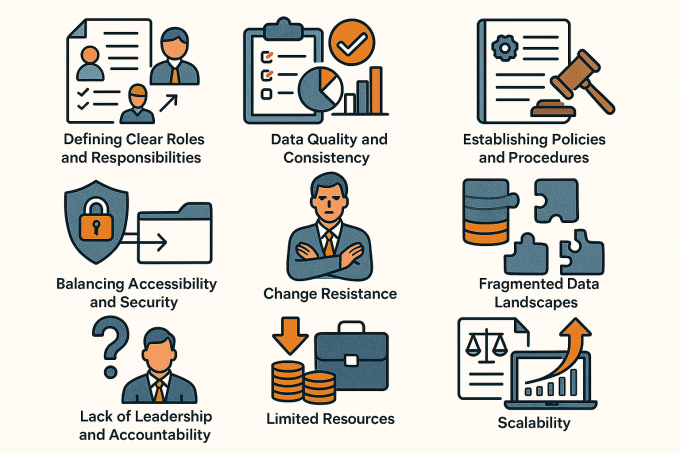
Balancing Accessibility and Security:
Providing appropriate access to users while protecting data from unauthorized access and breaches requires careful controls and monitoring.
Change Resistance:
Organizational resistance to new processes, technologies, or cultural changes impedes the adoption and success of governance programs.
Fragmented Data Landscapes:
Data is often scattered across disparate systems platforms and departments leading to data silos and inconsistencies.
Lack of Leadership and Accountability:
Without clear leadership, governance efforts become ad hoc, disconnected, and ineffective.
Limited Resources:
Budget, staffing, and technology limitations hinder effective implementation and sustainability of data governance.
Compliance and Regulatory Complexity:
Navigating evolving and complex regulations adds to governance burdens and risk management challenges.
Scalability:
Ensuring governance frameworks can evolve with growing data volumes and organizational complexity is challenging.
What will the consequences be?
- Poor data quality erodes trust and reduces data usability in decision-making
- Fragmentation and silos hinder data integration and collaboration
- Resistance to change slows adoption and alignment across business units
- Lack of leadership causes inconsistent policies, compliance risks, and operational inefficiencies
- Errors in customer data or operational data can lead to poor customer experiences, damaging the company’s reputation and trustworthiness in the market
- Employees waste time on data correction instead of productive work, increasing operating costs and slowing down business processes

Final Thoughts
Overcoming these challenges requires dedicated leadership, clear accountability, effective communication, proper resource allocation, and investment in tools and training to build a culture of data governance across the organization. Together these actions build a culture of data governance that aligns with business goals, reduces risks, and maximizes data value. A holistic, iterative approach embedded in everyday workflows enables organizations to overcome obstacles and achieve consistent, reliable data management throughout their operations.
Disclaimer – This blog provides general insights on data governance to help organizations improve data quality, security, and compliance. It is not a substitute for professional advice.